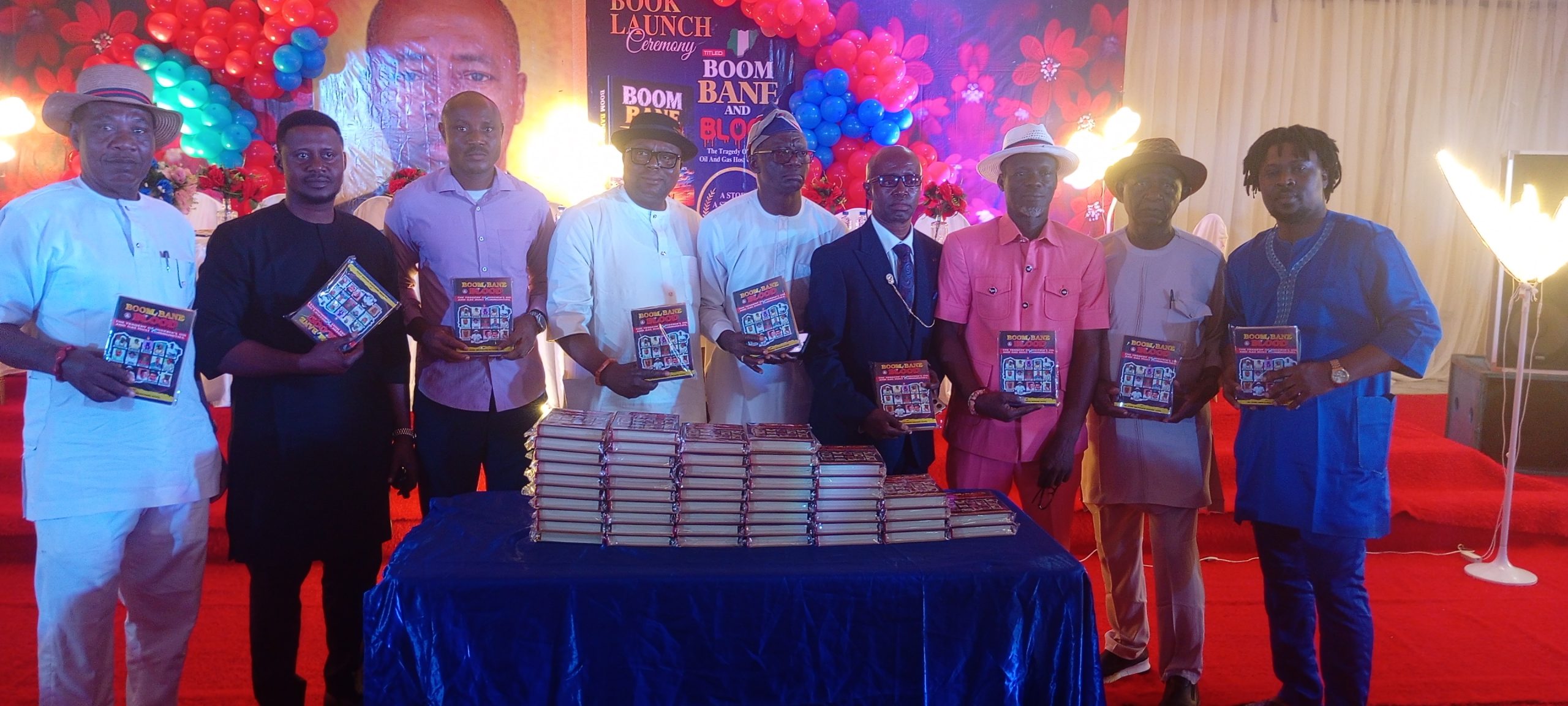
Dr Sheriff Mulade, a Niger Delta activist, has challenged the Delta State Government over the persistent neglect of oil-producing communities, declaring that the people whose land generates the state’s wealth are still suffering in the midst of plenty.
Mulade, who spoke at the public presentation and launch of The Boom, Bane and Blood, authored by Dr Richard Ayiwe, in Ughelli North Local Government Area of Delta State, called on Governor Sheriff Oborevwori to redirect greater attention and resources towards the development of oil-bearing communities, insisting that their contribution to the state’s economy must translate into improved living conditions.
He lamented that despite the enormous oil and gas resources extracted from the Niger Delta, many host communities remained without basic amenities, potable water and accessible roads.
According to him, the oil wealth that should have brought prosperity to the people has instead become a source of hardship, deprivation and environmental and socio-economic challenges.
” Nigeria is known all over the world because of its oil and gas resources. Anywhere oil is discovered, the state or nation concerned is often regarded as one of the richest in the world, and the indigenous people are expected to be among the wealthiest.
“But are we rich? No. Are we blessed? No. That means that, rather than being a blessing to us, the oil discovered in our area has become a source of pain. That is the pain we are talking about,” he said.
Describing the Niger Delta as the engine of Nigeria’s economy, Mulade rejected the characterisation of the region as merely the spine of the country, arguing that its oil and gas resources remain central to the nation’s economic survival.
“We are not just the spine; we are the engine of the Nigerian nation. Without the Niger Delta, can Nigeria move forward? We are the engine of this nation, but we are neglected and deprived. Today, we are all suffering. We are suffering in the midst of plenty,” he lamented.
The activist also expressed disappointment over the absence of government officials at the book launch, saying it was disturbing that representatives of the institutions responsible for managing the region’s resources were not present to listen to the concerns of the people.
He observed that political and social gatherings usually attracted government officials and prominent personalities, but events organised to discuss resource management and the welfare of host communities often received little attention.
“If this were a political gathering, everybody would be here. If it were a social gathering, people would be here dancing. They would pay us, and we would come and dance for them. But because we want to talk about how our resources are being managed, nobody is here for us to talk to,” he said.
Speaking on the establishment and performance of the Delta State Oil Producing Areas Development Commission, DESOPADEC, Mulade recalled the sustained agitation by oil-producing communities that culminated in the creation of intervention mechanisms to address the developmental challenges of the region.
He questioned the extent to which the commission’s interventions had translated into tangible development in host communities, particularly against the background of the funding arrangement intended to benefit oil-producing areas.
According to him, the allocation of 50 per cent of the relevant funds for host community development has not produced the expected results in several communities.
“At the time, 50 per cent of the funds were expected to be devoted to the development of host communities. But can we see the impact of that 50 per cent allocation in our communities today?
“Most of our communities are suffering. We hardly see the signs of government in our communities, not to talk of the 13 per cent derivation,” he said.
Mulade called for greater accountability in the management of resources meant for oil-producing communities, insisting that the people should be able to identify projects and development initiatives funded with such allocations.
He maintained that the continued hardship in host communities raised fundamental questions about whether the objectives behind the establishment of DESOPADEC and other intervention arrangements were being adequately achieved.
The Niger Delta advocate, further appealed to Governor Oborevwori to make host community development a central focus of his administration, particularly in the event of a second term.
While acknowledging the governor’s ongoing infrastructure projects, Mulade argued that oil-producing communities deserved more direct attention because of their contribution to the revenue that sustains the state.
He said the wealth generated from their land should be reflected in good roads, potable water, healthcare facilities, electricity and other essential social amenities.
“I want to call on the Delta State Government, led by our amiable governor, His Excellency, Rt. Hon. Sheriff Oborevwori, to pay greater attention to the plight of host communities.
“That is where our resources come from. The resources of the Niger Delta come from the host communities, and the resources of Delta State also come from these communities.
“We cannot continue to proclaim that Delta State is rich and has substantial financial resources when the wealth is not reflected in the lives of the people who produce it,” he stated.
Mulade said the development of Delta State should not be measured only by major infrastructure projects in urban centres but also by the quality of life of residents in rural and oil-producing communities.
He urged the governor to use his proposed second tenure to address the developmental imbalance confronting host communities, stressing that the people should not continue to suffer despite their contribution to the state’s economic fortunes.
On the federal bridges construction in Delta State Mulade also raised concerns over the utilisation of funds expected to be refunded to Delta State by the Federal Government for the construction and rehabilitation of federal roads undertaken by the state.
He acknowledged the bridges and flyovers being constructed by the Oborevwori administration but noted that several of the projects were located on federal roads.
He argued that the Federal Government should reimburse the state for qualifying expenditure on such projects, adding that the eventual utilisation of the refunds should take into account the developmental needs of oil-producing communities.
According to him, the resources used to execute federal road projects are partly derived from the wealth of host communities, making it imperative that they also benefit from any subsequent financial reimbursements.
“When these resources are refunded to Delta, who will receive this money? The money used to construct all these flyovers in Delta State today is being spent on federal roads, and the state must be reimbursed.
“But when they reimburse it, who will take this money? We must tell ourselves the truth,” he said.
He stressed that his concerns were not politically motivated but reflected the realities confronting communities that continue to lack basic infrastructure.
“This is not about political witch-hunting. It is important that Deltans and Nigerians must know that our host communities are suffering,” he added.
Listing some of the challenges, Mulade said several communities lacked access to clean drinking water and essential social amenities, while their interior roads had deteriorated to the extent that residents found it difficult to move around.
He therefore urged the state government to prioritise the provision of basic infrastructure in the affected communities.