By Nelson Egware
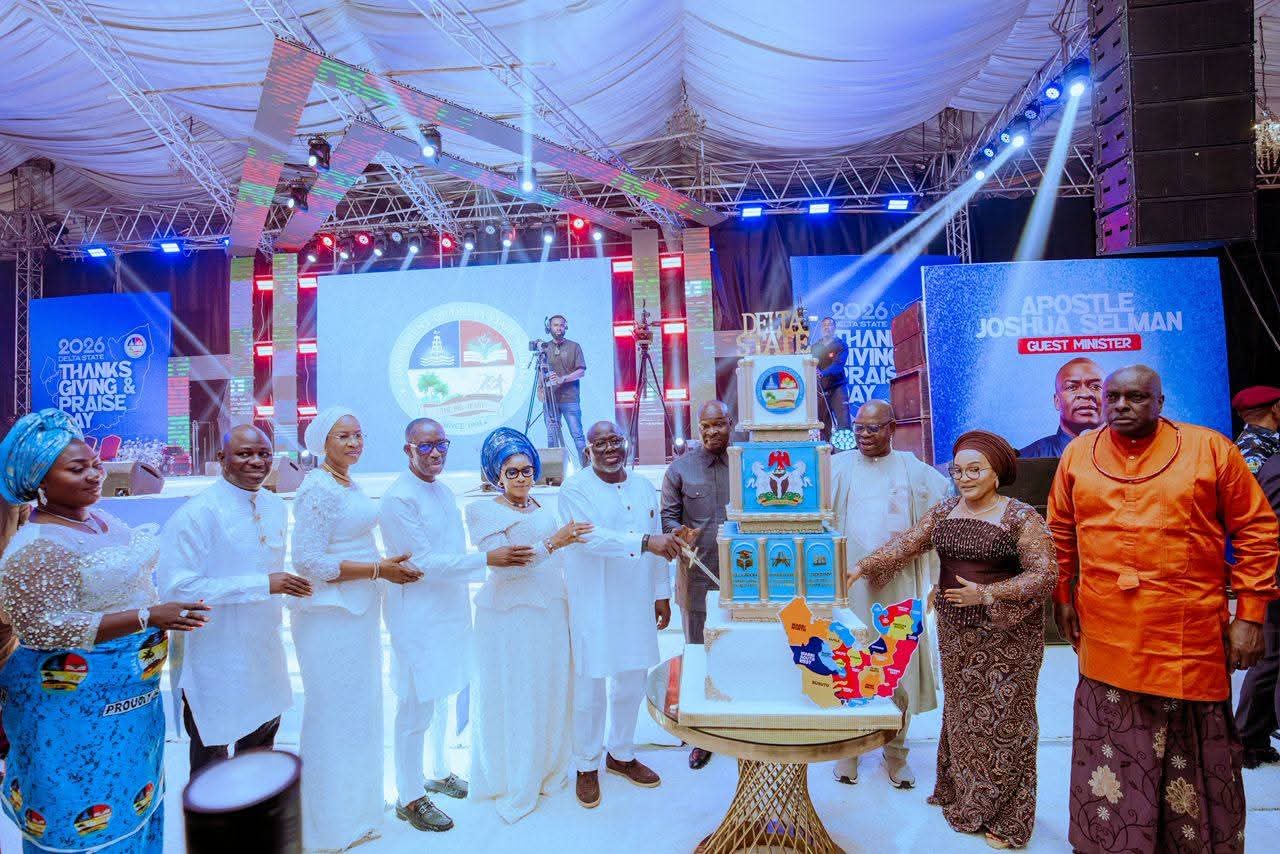
The atmosphere at the Dome Event Centre, Asaba, on May 29, 2026, was charged with celebration, gratitude and political symbolism. While the official occasion was the 2026 Delta State Thanksgiving and Praise Day, marking the third anniversary of Governor Sheriff Oborevwori’s administration, one development captured the attention of political observers and stakeholders alike, the unexpected but significant appearance of former Delta State Governor, Chief James Onanefe Ibori.
For many, Ibori’s presence at the event was more than a mere attendance at a state function. It was interpreted as a public affirmation of a renewed political relationship between the former governor and his successor in the state’s evolving political architecture.
The Thanksgiving and Praise Day itself has become an important annual tradition in Delta State. Instituted through legislation passed towards the end of Senator Ifeanyi Okowa’s administration, the law designated May 29 as a day for collective thanksgiving to God for peace, unity and progress in the state.
Interestingly, Governor Oborevwori played a central role in the birth of that law. As Speaker of the Delta State House of Assembly at the time, he presided over the legislature that passed the bill. Since becoming governor in 2023, he has continued to uphold the annual observance, transforming it into a gathering that brings together political leaders, traditional rulers, religious figures and citizens from across the state.
However, the 2026 edition carried an added layer of political significance.
Dressed in his trademark white Urhobo traditional attire and red cap, Chief Ibori arrived at the venue accompanied by his daughter, Hon. Erhiatake Ibori-Suenu, the member representing Ethiope Federal Constituency in the House of Representatives.
For seasoned observers of Delta politics, the sight was noteworthy.
Since Governor Oborevwori assumed office in 2023, Erhiatake had maintained a noticeable distance from state government activities and major official functions. Her appearance alongside her father at the governor’s anniversary celebration therefore sent a powerful message about changing political realities and emerging alignments within the Peoples Democratic Party (PDP) in Delta State.
The roots of the renewed relationship can be traced to recent political developments in Ethiope Federal Constituency. For months, political tensions had surrounded the quest by Hon. Erhiatake Ibori-Suenu to secure her party’s ticket for a second term in the House of Representatives. The battle attracted considerable attention, with various interests and stakeholders positioning themselves ahead of the 2027 political cycle.
Political insiders point to a crucial turning point, the visit by Chief Ibori to Governor Oborevwori at his Osubi country home. That meeting, according to several observers, marked the beginning of a reconciliation process that would eventually ease tensions and foster greater cooperation among political actors within the constituency.
Following the engagement, consultations reportedly intensified among leaders and stakeholders from Ethiope Federal Constituency. Gradually, the disagreements that had threatened to complicate the re-election ambitions of Ibori-Suenu gave way to consensus.
The outcome was significant. Hon. Erhiatake Ibori-Suenu eventually secured her second-term ticket without serious opposition, a development many attributed to the support and influence of Governor Oborevwori and key political leaders within the constituency.
In political circles, support is rarely forgotten. Thus, many analysts viewed Chief Ibori’s attendance at the governor’s third anniversary celebration as an act of appreciation and a demonstration of goodwill towards a governor who had helped facilitate a peaceful resolution of political disputes affecting his daughter’s political future.
Beyond the personal and political dimensions, the event also underscored the maturity of Delta’s political leadership. For years, Delta politics has been shaped by powerful personalities, shifting alliances and competing interests. Yet, the state’s political history has equally demonstrated an enduring capacity for accommodation and consensus-building.
The presence of Chief Ibori, Senator Ifeanyi Okowa and other prominent political figures at the same gathering reflected a growing recognition that unity remains essential for the stability and development of the state.
Governor Oborevwori himself reinforced this message during his address. In a speech laced with gratitude and humility, the governor acknowledged the contributions of his predecessors, including Chief James Ibori, former Governor Emmanuel Uduaghan and Senator Ifeanyi Okowa.
He noted that the achievements being recorded under his administration were possible because previous leaders had laid solid foundations upon which his government continues to build. The acknowledgment was not lost on the audience.
Many interpreted it as a deliberate effort by the governor to promote inclusiveness and continuity rather than political division. By publicly recognizing the roles played by former leaders, Oborevwori projected himself as a leader focused on consolidating gains rather than rewriting history.
The governor’s remarks appeared to resonate with Chief Ibori, who listened attentively throughout the programme. For a man widely regarded as one of the most influential political figures in Delta State’s democratic history, his attendance spoke volumes. It suggested that whatever differences may have existed in the past had largely given way to mutual respect and cooperation.
As the thanksgiving service progressed with prayers, worship sessions and messages from religious leaders, the political undertones remained impossible to ignore. The gathering became more than a celebration of three years in office. It evolved into a symbolic demonstration of political reconciliation, strategic partnership and party cohesion ahead of future electoral contests.
In many ways, the images from that day told the story better than words could. Chief James Ibori seated alongside Governor Sheriff Oborevwori. Erhiatake Ibori-Suenu participating in a state function she had previously avoided. Political leaders from different camps exchanging pleasantries and sharing a common platform.
For observers of Delta politics, these were not ordinary scenes. They were indicators of shifting alliances, renewed trust and a possible reconfiguration of political relationships within the state’s ruling establishment.
As Deltans gathered to thank God for peace and progress, the event also offered a glimpse into the evolving dynamics of the state’s political future.
And if there was one defining image from the 2026 Thanksgiving and Praise Day, it was undoubtedly the sight of Chief James Ibori “storming” Asaba to celebrate Governor Sheriff Oborevwori’s third anniversary, an appearance that spoke not only of thanksgiving but also of reconciliation, political maturity and the enduring power of strategic alliances in Delta State politics.