By Julius Agadaga, Yenagoa
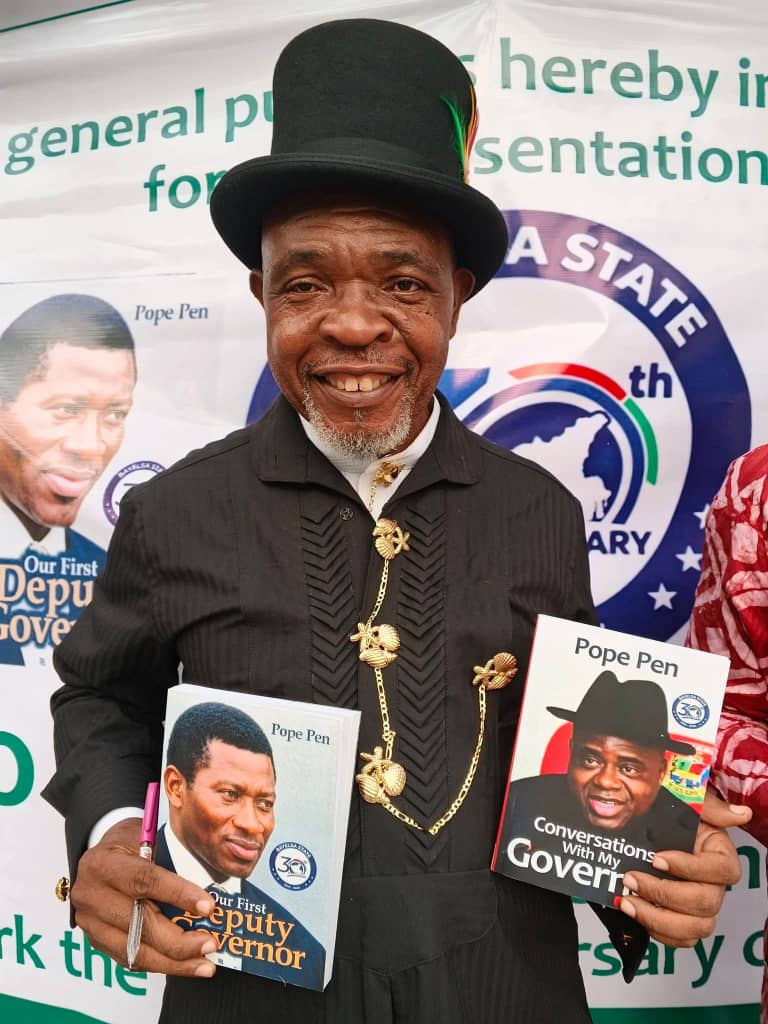
A renowned historian, Prof. Stephen Olali, has celebrated Bayelsa-born writer, Nengi Owei-Ilagha, describing him as a distinguished son of the state and the Ijaw nation whose enduring commitment to literary creativity has continued to promote the power of the written word.
Olali, who was Chairman of the Occasion at the public presentation of Owei-Ilagha’s two books, Our First Deputy Governor and Conversations With My Governor, said books and originality would remain relevant despite the growing influence of modern communication technologies.
He described literary gatherings as important platforms for intellectual engagement, knowledge sharing and the celebration of creativity, regretting that prominent politicians often failed to identify with literary events.
“These are the kind of events that hold great interest for me. They are not loud, there are no big drums rolling and no big-time politicians. If they were here, we would have celebrated them, but sometimes they don’t come to literary events, and that leaves a lot to be desired,” he said.
The President of Nembe Se commended Owei-Ilagha, popularly known by his pen name, Pope Pen, for remaining consistent in his literary pursuits and sustaining the relevance of the pen.
He described the author as a great son of Bayelsa State, the Ijaw ethnic nationality and Nembe Se, adding that his contribution to literature deserved recognition and celebration.
“I want to congratulate the author, Nengi Owei-Ilagha, a great son of Bayelsa State, Ijaw ethnic nationality, a great son of Nembe Se. I celebrate you. You have never reduced the power of the pen, so it is only fitting when you chose the pen name Pope Pen,” Olali said.
Recalling his personal relationship with the author, the professor disclosed that he once called Owei-Ilagha from the airport to tell him that he was “eating one of your books for breakfast”, as a way of acknowledging his literary contributions.
He said the presentation was an opportunity to celebrate a writer whose dedication to original thought and creative expression had continued to produce works worthy of public attention.
“Books will never go away and originality will not go away, and we will keep reading books,” he declared.
In his remarks, Owei-Ilagha said his motivation for writing was rooted in his belief that life was a gift which should be used meaningfully to document experiences, express ideas and contribute to correcting societal shortcomings.
According to him, writers have a responsibility to observe events around them, document their experiences and use their creative abilities to influence positive changes in society.
“The inspiration is straightforward. When you come to realise that your life is a gift, you don’t own your life; it is a gift, and our duty is to make use of the time that we spend on the face of the earth.
“We’re just passing through, so we should be able to take note of what we experience in our lifetime, express ourselves and correct what we can while we can. That is very, very important,” he said.
Reflecting on his literary journey, the author traced his passion for writing to his primary school days when he began expressing himself through scribblings on chalk and slate before progressing to pen and paper.
He expressed gratitude to God for the opportunity to develop his writing talent over the years, noting that he now has more than 40 books to his credit.
“From handling a chalk and slate, scribbling on chalk and slate, we grew into pen and paper. And then to this present day where one has grown to the point of having over 40 books with my name on them, I am grateful for the gift of self-expression,” he said.
The 62-year-old author, who will soon turn 63, described self-expression as an essential quality of a writer, explaining that the ability to communicate ideas and inspire others to respond to societal issues distinguishes a committed writer.
He disclosed that his decision to pursue creative writing as a career was made at the age of 19 while he was a second-year student at the University of Port Harcourt.
Owei-Ilagha said the works of renowned literary figures, including Chinua Achebe and Wole Soyinka, inspired him to take writing seriously and pursue his ambition of becoming an internationally recognised author.
He said his childhood dream was to attain the literary stature of William Shakespeare, adding that feedback from readers over the years had encouraged him to believe that he had secured a place among notable writers from Bayelsa State and Nigeria.
“It has been a dream, a childhood dream, from a long way back, that I wanted to be an international writer as famous and as popular as William Shakespeare. Today, I think if you name the number of writers from Bayelsa State and even in Nigeria, my name is somewhere in one small niche. I’m grateful for that,” he said.
On his versatility as a broadcaster, essayist, poet and novelist, Owei-Ilagha attributed his diverse talents to divine grace, citing the biblical injunction that a lighted candle should be placed on a stand to illuminate the house rather than be hidden.
He also recalled his broadcasting career, disclosing that he became the first youth corps member to present a programme on the newly established FM station in Makurdi, Benue State, in 1987.
Since then, he has worked with several radio stations across the Niger Delta, including Radio Rivers, Royal FM, Rhythm FM and Ray Power, before joining Radio Bayelsa, where he currently works.
The author urged emerging writers not to abandon their passion because of the challenges associated with the profession, advising them to remain dedicated, committed and disciplined.
He further cautioned writers against unnecessarily offending others in the course of communicating their ideas, stressing that messages could be passed across effectively without stepping on toes.